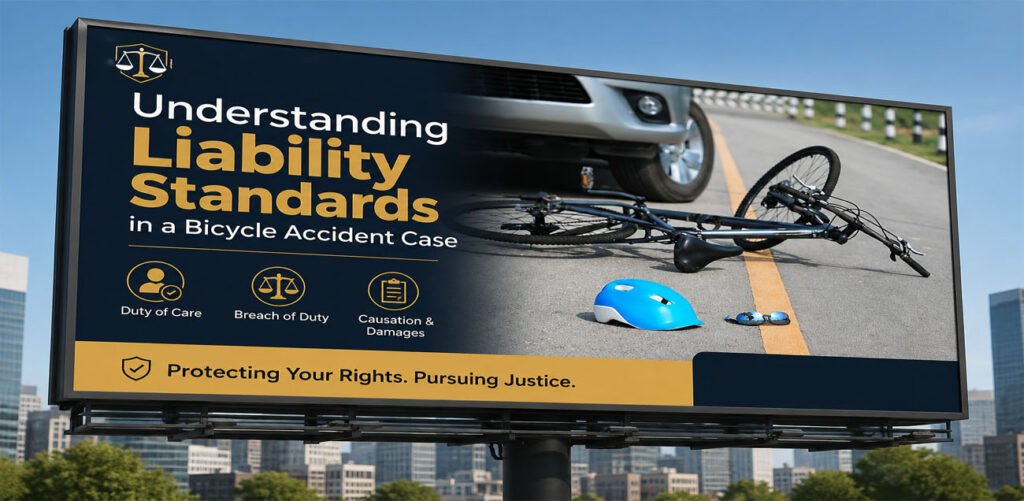
Understanding Liability Standards in a Bicycle Accident Case

Determining responsibility after a cycling collision involves more than deciding which person received a traffic citation. Liability depends on what each party was required to do, how their conduct contributed to the incident, and whether reliable evidence supports that account. Clear analysis can reveal why two bicycle accident cases with similar injuries may produce very different results.
Liability Begins With the Duty to Use Reasonable Care
Drivers and cyclists share a basic responsibility to act with reasonable care around others on the road. Motorists must watch for smaller vehicles, obey traffic controls, maintain safe passing distance, and avoid turning across an occupied bike lane. Riders also have duties, which may include following signals, traveling in the proper direction, using required lighting, and signaling before changing position.
Reasonableness depends on the conditions present before the bicycle crash. Heavy rain, poor lighting, road construction, crowded intersections, and blocked sightlines may require more caution than an open street on a clear afternoon. Courts and insurers often compare the person’s conduct with what a careful road user would likely have done in the same situation.
What Conduct Counts as a Breach of Duty?
A breach occurs when someone fails to meet the level of care required under the circumstances. Texting behind the wheel, speeding through an intersection, opening a parked car door without checking, or turning without yielding may support negligence in a bicycle accident case. The same principle can apply to a business that sends an unsafe commercial vehicle onto the road or a repair shop that installs bicycle parts incorrectly.
Traffic violations may provide strong evidence, but they do not always settle the entire dispute. A citation can support bicycle accident claims by showing that an officer observed unlawful conduct, yet insurers may still question whether that violation actually caused the collision. Conversely, the absence of a ticket does not prove that everyone acted carefully.
Context often determines whether an action was unreasonable. A driver traveling below the posted limit might still move too fast for fog, congestion, or a narrow street lined with parked vehicles. Likewise, a cyclist may lawfully occupy a traffic lane when road debris, drainage grates, or an opening car door makes the shoulder unsafe.
Causation Connects Careless Conduct to the Bicycle Crash
Negligence alone does not establish liability unless that conduct contributed to the crash and resulting harm. A driver may have been distracted earlier in the trip, but the claim still needs evidence showing that distraction played a part in the impact. Video, phone records, witness statements, skid marks, and vehicle data can help connect the careless act to the collision.
Medical causation requires a similar link between the bicycle accident and the rider’s injuries. Emergency records, diagnostic testing, physician notes, and follow-up care may show that a fracture, concussion, nerve injury, or soft-tissue condition developed because of the impact. Delayed symptoms can still be related, although insurers may challenge them more aggressively without prompt documentation.
Shared Fault Can Change the Outcome of a Claim
Responsibility does not always rest entirely with one party. A motorist might make an unsafe turn while the cyclist rides without proper lighting, or a driver may pass too closely as the rider moves unexpectedly around a pothole. Investigators must separate each action and decide how much it contributed to the bike accident.
State rules determine what happens after fault is divided. Certain jurisdictions reduce compensation according to the injured person’s percentage of responsibility, while others can block recovery once fault reaches a specific level or even when the rider bears a small share. Because these standards differ, bicycle accident cases require careful attention to the law that applies where the incident occurred.
Insurance companies often focus on cyclist conduct to reduce what they must pay. Adjusters may question lane position, visibility, helmet use, signaling, speed, or compliance with a traffic device. Helmet arguments, however, may relate more closely to injury severity than to who caused the crash, depending on the facts and governing law.
Strong Evidence Turns a Liability Theory Into a Supportable Case
Physical and digital evidence can clarify movements that witnesses remember differently. Scene photographs may show blocked signs, faded markings, debris, impact points, or vehicle positions, while surveillance footage can capture the sequence of a turn or lane change. Damaged bicycles, helmets, clothing, and vehicle panels may also reveal the direction and force of contact.
Timing affects how much useful proof remains available. Businesses may overwrite camera recordings, road crews may repair defects, vehicles may be fixed, and witnesses may forget details. Early preservation can protect material needed to evaluate fault rather than leaving the claim dependent on competing statements.
More Than One Party May Share Legal Responsibility
Drivers are not the only possible defendants in bicycle accident claims. Employers may bear responsibility for employees who cause collisions while performing job duties, while vehicle owners may face questions when they knowingly allow an unsafe person to drive. Government agencies, contractors, property owners, manufacturers, and repair businesses may also become involved when road defects or faulty equipment contribute to the incident.
Commercial bicycle accident cases can require review of training files, delivery schedules, driving histories, maintenance records, onboard cameras, and company policies. Evidence may show that an employer encouraged rushed driving, ignored prior safety problems, or failed to maintain a truck with dangerous blind spots. Identifying additional coverage can matter when the injuries exceed the limits of a personal auto policy.
The Lackey Law Firm can investigate how a bicycle crash occurred, assess the conduct of each involved party, and gather evidence needed to address disputed liability. Its legal team can review roadway conditions, traffic rules, video, medical records, witness accounts, insurance coverage, and possible shared fault, helping injured riders present bicycle accident claims built on clear facts rather than assumptions.